UNFCCC Engagement
The Adaptation Research Alliance (ARA) engages with the United Nations Framework Convention on Climate Change (UNFCCC) to ensure its processes benefit, to the extent possible, from the depth and breadth of expertise within the Alliance.
The ARA does this by participating in the annual Conference of the Parties (COP) and contributing to the first Global Stocktake (GST1) and to the knowledge base on loss and damage.
Global Goal on Adaptation
A compilation of illustrative targets and indicators for the Global Goal on Adaptation (GGA) was submitted by the UN Foundation on behalf of a consortium that included the ARA. The Alliance also produced a video.
Related Resources
- Compilation of illustrative targets and indicators for the Global Goal on Adaptation
- Seven priorities for an inclusive Global Goal on Adaptation
The First Global Stocktake
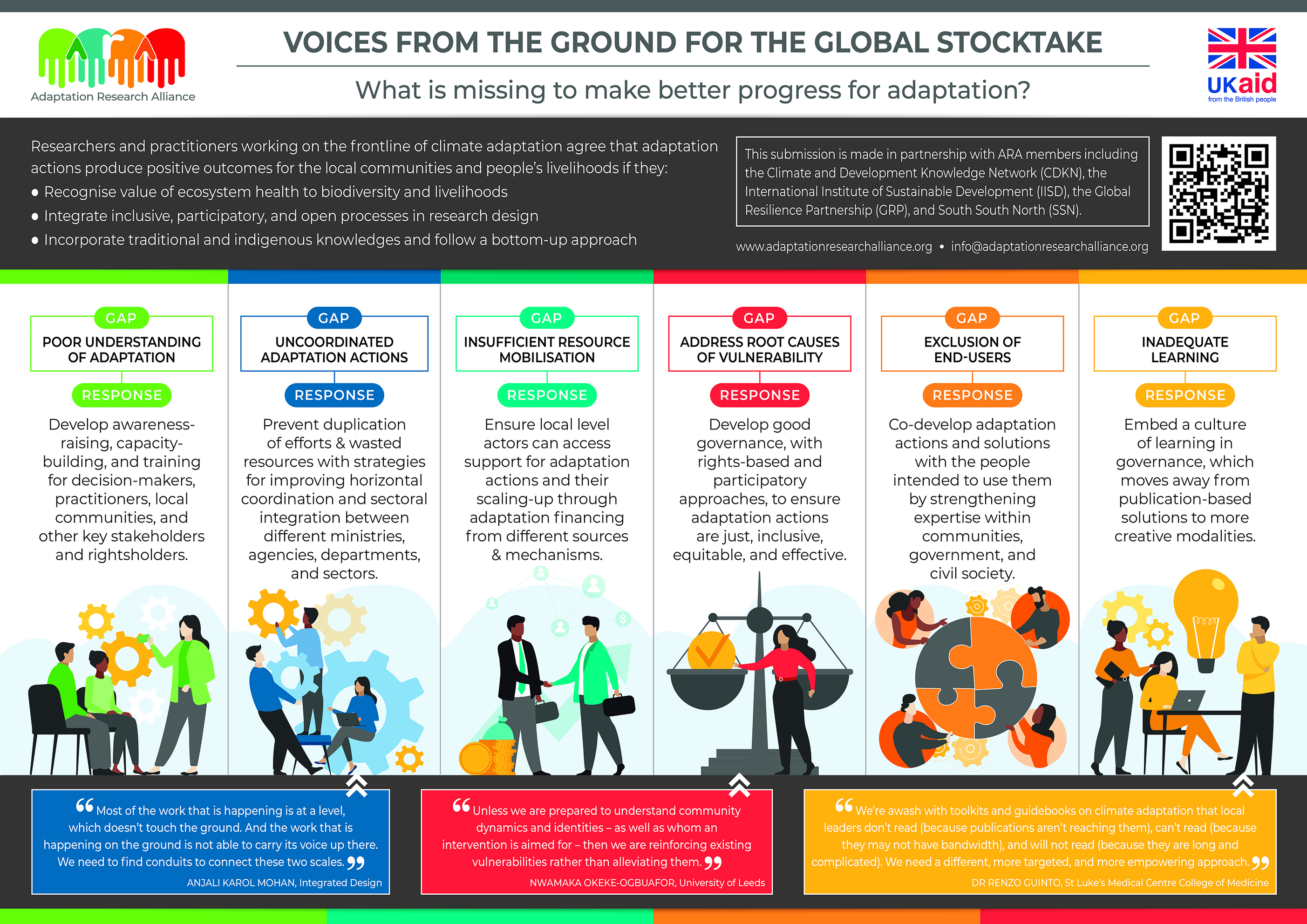
The ARA has enabled submissions to the UNFCCC GST1, bringing in the voices of researchers and practitioners working on the frontline of climate adaptation about what is missing to make better progress on adaptation.
Related Resources
- Poster: ARA submission to the Global Stocktake
- Video: Global Stocktake: Making local action on adaptation count
- ARA submission to the UNFCCC Global Stocktake
ARA Knowledge Catalyst Grant for Emerging Adaptation Professionals in the Global South
In 2025, the ARA launched the Knowledge Catalyst Grant for Emerging Adaptation Professionals in the Global South to enhance their contribution to global climate knowledge processes, including the IPCC Seventh Assessment Report (AR7), especially Working Group II. The Knowledge Catalyst Grant builds on lessons from the former Grassroots Microgrants programme.
It aims to assist early-career researchers, practitioners, and knowledge brokers in transforming existing or near-complete work into peer-reviewed or high-impact publications.
What the Grant Supports
Participants receive targeted support to move their work toward publication and engagement with global processes. This includes:
- Technical writing and editorial support
- Mentoring, including by IPCC authors and senior researchers
- Write-shops and peer learning
- Open-access publication support
- Opportunities to engage with IPCC-related platforms and networks
Delivery Approach and Regional Implementing Partners
Delivery is carried out by ARA member organisations acting as regional implementing partners. These partners identify and support cohorts of emerging professionals with work that can be strengthened for publication.
The Center for Climate and Resilience Research (CR2) in Latin America and the Caribbean will strengthen the participation of early-career adaptation researchers and locally grounded evidence from Latin America in global adaptation processes, including IPCC AR7. Through mentoring from experienced IPCC authors and structured writing support, the project will enable Emerging Adaptation Professionals to translate regional and non-academic evidence into peer-reviewed, policy-relevant outputs, while generating approaches that ARA can adapt in other regions.
Transitions Research in Asia will support early-career adaptation professionals in Asia to contribute more effectively to global adaptation debates and to publication processes aligned with IPCC AR7 priorities. The project combines targeted mentoring, writing support, and integration into ARA networks to strengthen publication pathways and produce a replicable model for capacity development in the Global South.
The Africa Centre for Technology Studies (ACTS) will implement a six-month fellowship programme to support early-career adaptation professionals in Africa in producing policy-relevant, publishable research aligned with IPCC AR7 priorities. Through targeted training and mentored write-shops hosted by the ACTS Pathways Academy, the project aims to increase the visibility and influence of African adaptation research in global assessment and policy processes. The Secretariat offers coordination, quality assurance, and connections to journals and global platforms. The approach aims to keep transaction costs low and direct support towards meaningful outputs.
Expected Results
The grant will:
- increase authorship and visibility of Global South adaptation professionals
- support engagement with the IPCC AR7 and related processes
- strengthen mentoring and publication ecosystems in the regions
- ensure practitioner and local knowledge is treated as credible evidence
Outputs
- At least 15 emerging professionals supported across regions
- Manuscripts submitted to peer-reviewed or mentored publication pathways
- Write-shops and mentoring delivered through regional partners
- Practitioner and grey literature developed into publishable outputs
- Partnerships with journals, including mentoring and special issues
Why this Matters
Knowledge of adaptation from the Global South produced by scholars and practitioners from the Global South remains underrepresented in global assessments and publications. This grant focuses on what is already available, aiming to make it visible, accessible, and credible in decision-making processes.
Comments
There is no contentYou must be logged in to reply.