Co-designing in Tandem: Case study journeys to inspire and guide climate services


This weADAPT article/case study is an abridged version of the original text, which can be downloaded from the right-hand column. Please access the original text for research purposes, full references, and to quote text.
Summary
This study evaluates and improves the Tandem framework for co-designing climate services to make it more effective and applicable in a range of geographic and decision contexts. The framework is practical, adaptable, and can be tailored to different needs. Researchers applied Tandem in three diverse settings: rural Indonesia (agriculture), urban Sweden (flooding and heat stress), and Colombian river basin communities (water scarcity). Findings show Tandem’s effectiveness in transforming useful data into usable information, strengthening networks, improving climate information uptake, boosting user capacity and confidence, and facilitating collaborative learning and action.
Introduction
There is increasing evidence that iterative stakeholder engagement and reflexive knowledge exchange, rather than the production of more, or “better” information, increases the likelihood that climate information will be used in decision-making. We conduct three diverse case studies in Indonesia, Sweden and Colombia to examine the effectiveness of Tandem, a transdisciplinary framework to co-design climate services, and use the results to refine the framework to enhance its efficacy.
Transdisciplinarity uses collaborative methods to bring scientists, policymakers and practitioners together to co-produce the necessary knowledge to address societal problems. Co-production processes have the potential to strengthen individual and institutional capacities, collaboration, communication, and networks, and thus to accelerate climate-resilient decision-making and action. In these processes, intermediaries connect different actors and knowledge types to help to tailor and customize decision support tools to fit specific contexts and needs. Such actors facilitate communication and knowledge exchange across diverse networks of stakeholders and provide insight into political contexts creating entry points for climate information, using both formal strategies and more tacit, informal strategies.
Key enablers for effective and holistic decision-making: Key enablers of information uptake and use are a deeper understanding of the needs of the decision-maker and of the decision-making context by climate information providers, and a clearer understanding of the potential value and limitations of such information by users. Enhancing the capacities of intermediaries can enable this space to reduce the “usability gap” between climate science and information use in decision-making. Effective decision-making is also enabled by timely and tailored provision of decision-relevant information, in appropriate formats and language, to create a shared understanding of, and reduction in the use of technical terminology.
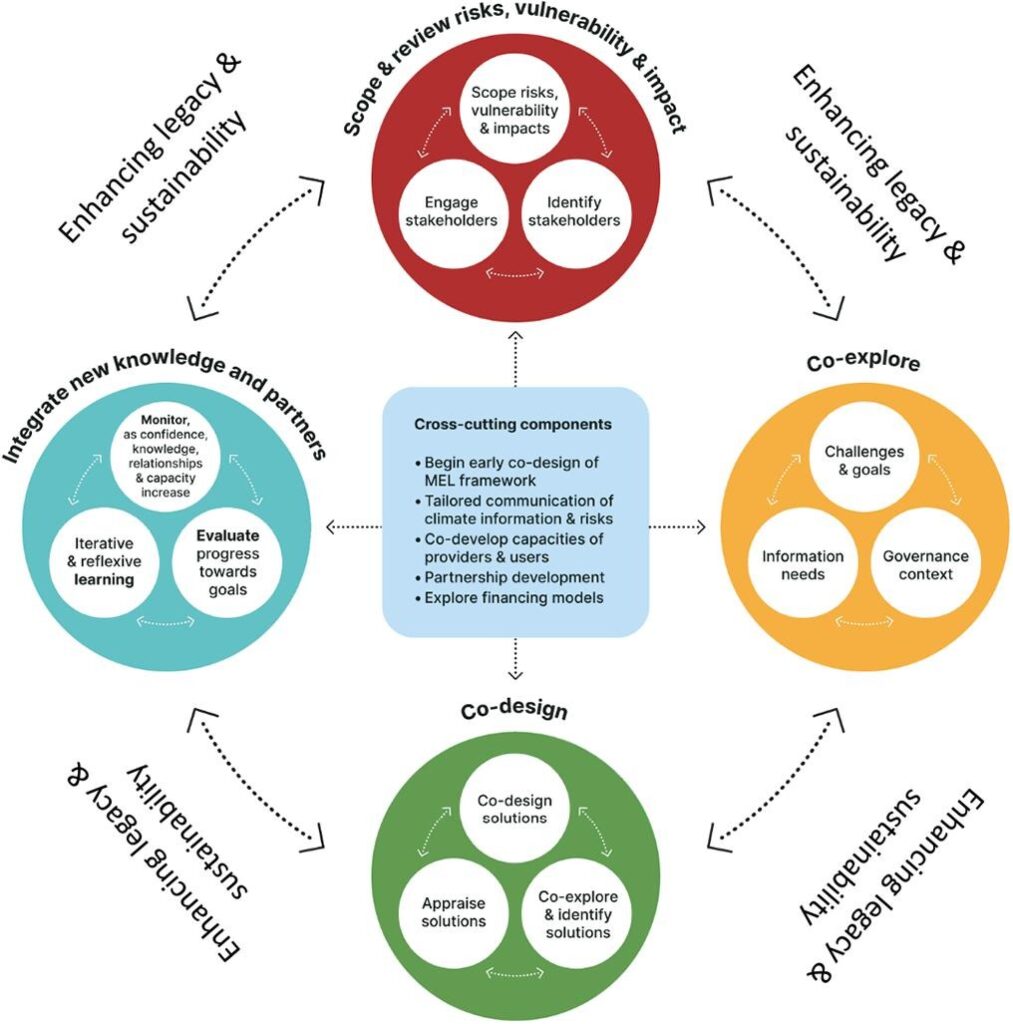
The Tandem framework: Tandem was created to offer a collaborative guidance framework for co-produced and process-led climate services. We propose that Tandem goes further than existing, similar tools by offering practical guidance in the form of co-exploratory questions for each stage of the co-design process. More specifically, Tandem supports stakeholders to work together to create a shared understanding to co-design and co-develop adaptation solutions and climate services that promote long-term climate resilience and sustainability. Tandem provides a structure for i) understanding decision needs; ii) guiding actors in designing and delivering an effective transdisciplinary knowledge-integration process; and iii) enhancing individual and institutional capacities, working relationships, and networks necessary for longer-term change and action. The Tandem framework is circular to emphasize the iterative and reflexive nature of the process.
Methodology
We applied Tandem in three settings: at the rural scale in Southeast Asia, where smallholder farmers are confronted with climate impacts on agriculture, at the municipal scale in Northern Europe, specifically in Sweden where urban planners are addressing climate-related flooding and heat stress, and at the basin scale in Latin America, specifically in Colombia where climate change is leading to water scarcity, raising issues about access and equitable use of water.
A literature review and document analysis of 11 existing Tandem publications was carried out and ex post meetings were then organized involving case study team leaders to discuss and compare results. The literature review and document analysis were used to inform interviews between the literature review external researcher, Tandem lead researcher and case-study team leaders. Data from the Tandem literature and interviews were inductively and iteratively coded in the qualitative analysis software, AtlasTi, to derive high-level concepts.
Case studies and results
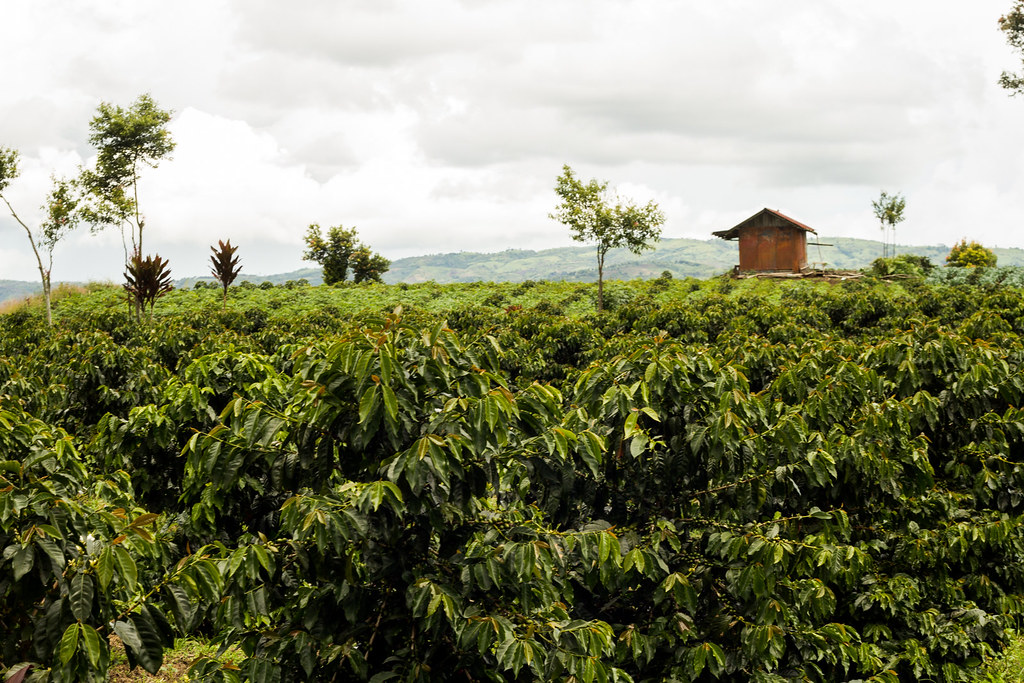
Coffee and cacao farming in Indonesia: Researchers worked with a well-established local intermediary and NGO in three locations in Bali to facilitate dialogue between the Indonesian Meteorology, Climatology, and Geophysical Agency (BMKG); agriculture extension workers; and coffee and cacao farmers on their individual needs and challenges.
The key adaptation challenge identified was a decline in the effectiveness of the traditional ecological calendar to support coffee and cacao farming decisions. Historically, weather forecasts had not been used by farmers, who lacked communication with BMKG, and questioned the accuracy of their forecasts, their relevance, and their own strong belief in using a traditional agriculture calendar and traditional ecological knowledge (TEK). Attempts to communicate seasonal climate information at training workshops by BMKG staff had been unsuccessful and BMKG officials were not inclined to provide TEK-based climate information because they believed it incapable of keeping pace with rapidly changing climate trends. Farmers wanted short-term solutions to unpredictable weather events; by contrast, BMKG valued long-term information based on climatic trends.
Tandem was used in the development of training workshops to identify the types of actors to engage, and later, in establishing a shared understanding of their respective objectives, pluralistic values, and knowledge systems. The co-productive process created trust and identified opportunities to bridge the gap between farmers and BMKG highlighting the overlooked value of TEK in climate services. BMKG introduced a TEK module that integrated the traditional Balinese calendar, in the second field school, becoming known as the School of climate and Living Tradition (SaLT). This showed how TEK aligned with BMKG’s climate information and further increased trust and rapport with farmers.
River basin management in Colombia: In Colombia, Tandem was integrated into the formulation of the hydrographic basin management plan to ensure inclusive and adaptive land management and foster climate education and behavioural change in the coffee producing region of the Campoalegre River basin. These plans were created with the involvement of a basin council, a participatory group that included representatives from local and regional communities and institutions via a series of interviews and several workshops. The basin council identified the adaptation challenge, climate and non-climate risks, and reviewed existing climate services. It revealed that users found it hard to access information that they needed and even if they did find it, it was hard to use.
Co-designing of adaptation strategies then involved using many different forms of engagement. This processes revealed underlying power dynamics at play among actors, with certain voices often dominating conversations, particularly at the start of the process. To address this, a subsequent workshop employed individual questionnaires to provide more opportunities to those who were dominated in group dialogues to provide input. Workshop participants collaboratively designed a new graphical interface for a climate service for the basin. This made available climate information more accessible and relevant to them.
Urban municipal planning, Sweden: In Sweden, Tandem was applied in an urban-planning context in the cities of Karlstad and Stockholm through the HazardSupport project – a collaboration with the Swedish Meteorological and Hydrological Institute (SMHI) and municipal officers from Karlstad and Stockholm in technical services, property management, environmental administration, and urban planning, building and development. Karlstad municipality sought to evaluate the potential effects of building a flood defense wall, to meet the demand for housing in the residential area of Skåre, while addressing risks of multiple water hazards in a changing climate from cloudburst events and spring floods. Stockholm sought to evaluate options to address heat stress in infrastructure planning while meeting the housing demands of a rapidly growing population.
After co-exploring the adaptation challenges, SMHI conducted a series of scenario modeling and impact assessment exercises and identified climate services for both municipalities. Tandem helped to apply a structured co-production approach to identifying and exploring adaptation solutions resulting in rich and fertile discussions. Tandem also enabled a co-exploration of different motivations and capacities and in turn a deeper understanding of how different actors arrived at preferred solutions. The iterative exchange of data and local experiential knowledge continued after the workshops, demonstrating the lasting relationships a well-designed and facilitated co-productive process typically builds.
Key benefits of Tandem
The case studies collectively demonstrate the multiple benefits of a process-centric and non-prescriptive approach to shared reflection and learning through the Tandem framework, supporting the development, uptake and use of climate information. This helps create trust and strengthened relationships and networks through the power that stems from convening a range of actors with different types of knowledge, increased capacity and confidence of both providers and users to create entry points and bridges across different problem and decision domains.
Key benefits identified across case studied include:
- Increasing trust − moving from ‘useful’ to ‘usable’ climate information;
- Institutional embedding through strengthened relationships and networks;
- Improving climate information uptake and use for planning and decision-making;
- Increasing capacity and confidence of users and providers; and
- A non-prescriptive guide for collaborative and iterative learning.
Refining and improving Tandem
Learning from the application of Tandem and its added value, this section discusses how Tandem can be improved to further enhance the co-creation of climate services that support accelerated, inclusive and equitable climate resilient action as suggested by case study evidence.
- Researchers and practitioners in the case studies found that ‘scoping’ and understanding the different climate (and non-climate) context-specific vulnerabilities and risks before identifying the priority adaptation challenges was important. For instance, in Colombia, interviews started with an unstructured process that allowed council members to identify climate and non-climate stressors.
- Another lens is that of gender and social equity to co-explore power dynamics that may impede climate adaptation planning and implementation. In Indonesia, the co-productive process was important to build trust between local farmers and national level climate scientists to the degree that their knowledge could be given equal consideration in the process.
- References to ‘other’ knowledge in the guidance were adapted so that TEK was on equal footing with scientific knowledge and was not at risk of being considered ‘additional’ when the guidance was applied.
- Recognizing the complexities of politics, power and the informality of many policy and planning processes and understanding both horizontal and vertical governance (both formal and informal) can address the lack of coordination and collaboration between and within siloed institutional departments.
- The case studies showed that the Tandem process can be embarked upon at any stage, and this is more transparent in the circular, updated version. In the Swedish case studies, the process of co-identifying adaptation challenges was integral, but a detailed scoping and review phase was not needed. Conversely, in Colombia, more guidance was needed to build a better understanding of the context prior to identifying and engaging stakeholders, so further scoping and review questions were needed.
- All three case studies highlight the need for MEL frameworks, as creating a culture of learning and reflection is emphasized in the guidance. Since co-production processes create many non-tangible outcomes that are difficult to measure, co-developing impact indicators that monitor progress towards resilience goals are re-emphasized early in the Tandem guidance.
Limitations and next steps
Given the significant benefit of the enhanced gender and social equity lens, future Tandem studies should also integrate questions that interrogate any potential power dynamics and knowledge biases. This may require exercises that can address sensitive questions e.g., using social network mapping to identify power relations, gender identities in all aspects, and existing and/or different forms of knowledge types and flows.
Additionally, Tandem requires a carefully designed, negotiated and iterative process and this may be a challenge in time bound projects with limited and predefined allocation of resources and staffing. On the other hand, there is no short cut to managing complex problem solving collectively and achieving long-term sustainability. This speaks to the need to build capacity on the facilitation of knowledge co-production processes with intermediaries and boundary partners early on, to increase the likelihood of building a legacy for this approach when participants change roles.
Finally, MEL is notoriously hard to carry out due to the difficulty in attributing outcomes to interventions, particularly when many purported benefits of Tandem are ‘soft’ or intangible in nature. However, there are emerging efforts that can support this process in the field of climate services co-production building on standards and principles in adaptation, humanitarian and development sectors, and agreed upon attributes and definitions of climate services.
Suggested Citation:
Bharwani, S., Å. Gerger Swartling, K. André, T.F. Santos Santos, Salamanca, A., N. Biskupska, T. Takama, L. Järnberg and Liu, A. (2024). Co-designing in Tandem: Case study journeys to inspire and guide climate services. Climate Services, [online] 35, pp.100503–100503.
doi: https://doi.org/10.1016/j.cliser.2024.100503
Further resources

Comments
There is no contentYou must be logged in to reply.